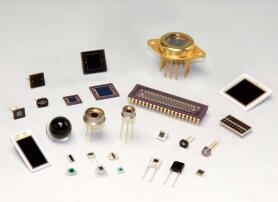
hamamatsu is the largest manufacturer for many kinds of Si Photodiodes. They’re a Japanese company . You can check hamamatsu SI photodiodes at this PDF datasheet.
Si photodiodes ( Silicon PIN photodiodes ) are available in a wide variety of active areas to accommodate various applications. The PIN structure allows high quantum efficiency and fast response for detection of photons in the 400 nm to 1100 nm range.
Silicon makes a fine photodiode. Si photodiodes ( Silicon photodiodes ) are an excellent choice for many visible-light applications. This is the primary restriction to keep in mind with silicon: it is sensitive primarily to the wavelengths of visible light.
The photodiode is a semiconductor device that has a nearly linear relationship of current to received optical power. The easiest way to think of the photodiode is just as a current source, where the current amplitude is a linear function of optical power incident on the photodiode.
Photodiodes are generally reverse-biased – the cathode will be operated at a higher voltage than the anode. Photodiodes can also be zero-biased, with both cathode and anode at the same potential. The preference for reverse bias in many circuits is because of the somewhat lower photodiode capacitance that occurs with a non-zero reverse bias.
Si photodiode arrays Si photodiode array is a sensor with multiple Si photodiodes arranged in a single package. An image sensor can be configured by arranging multiple photodiodes. It can be used in a wide range of applications such as light position detection, imaging, and spectrophotometry.
photodiode circuit
Sharp photodiode circuit
photodiode array detector
Diode array detector (DAD, PDA: Photodiode Array Detector) Photodiode arrays (semiconductor devices) are used in the detection unit. A DAD detects the absorption in UV to VIS region.
Principle and Feature of Various Detection Methods (1)
photodiode amplifier
photodiode sensor
Photodiode Types
1) PN photodiodes
2) PIN photodiodes
3) Schottky type photodiodes
4) Avalanche photodiodes
All of these types provide the following features and are widely used for the detection of the existence, intensity, position and color of light.